The Morse Code
Modern communication devices like cell phones and telephones may look like an inevitable part of human communication technology. It feels like these things have existed since eternity, but these are comparatively very young technologies. This does not mean in any way that there was no communication over longer distances between people back in the day. People communicated through Morse code. So, Morse code can be termed as the predecessor to modern communication devices. Despite being a technology that is over one and a half century old, it’s still used today among some radio users and by some ship crews. You might even have a grandpa who used it on his ham radio. Learning Morse is a fun and satisfying hobby now a days and you can share it with all oldies in the neighbourhood. There are always some gramps in all neighbourhood who still know this archaic art. Back in the day, Morse code was one of the most desired man skills.
Historical Archives of Morse Code
Morse code was invented by a American artist named Samuel F. B. Morse in the 1830s. Along with the American physicist Joseph Henry, and Alfred Vail, he developed an electrical telegraph system. They began work on the electric telegraph in 1832, developed a practical system in 1844, and patented this technology in 1849. Around 1837, Morse, developed an early forerunner to the modern International Morse code. The code that Morse developed for use with his system went through a few transformations before we saw the code we’re familiar with today. Initially, Morse code transmitted only numbers. The transmission’s receiver would then use a dictionary to translate the numbers into words. But that proved to be too much time consuming and tedious. Soon the code was expanded to include letters and punctuation.
On 24th May 1844, Morse code was used for the first time. “What God hath wrought.”; was the first ever message that was transmitted via Morse code. This was done by Samuel F.B. Morse himself. The original telegraph system had an apparatus on the receiving end that spat out a string of paper with indentations over it. Short indentations were called “dots” and longer ones were called “dashes.” As telegraph users became more proficient, they soon dispensed with the paper tape and deciphered code by ear. In those days telegraph users were considered highly skilled if they could decipher Morse code by ear.
Ten years after the first telegraph line was opened in 1844, over 23,000 miles of telegraph line crossed America. The telegraph and Morse code had a very positive effect on the development of the American West. Railroad companies used it to communicate between stations and telegraph companies started to pop up everywhere, which shortened the amount of time needed to communicate across the country significantly.
During this time, European countries also had developed their own system of Morse code. The code used in America was called American Morse code or Railroad Morse code; while the code used in Europe was called Continental Morse code.
In the 1890’s radio frequency communication was invented and Morse code was used for transmitting messages at sea. As radio frequencies got longer, international communication soon became a possibility. This created a need for an international standard code. In 1912, the International Morse code was adopted for international communication. However, many railroads and telegraph companies continued using Railroad Morse code because it was faster to send. Today, American Morse code is almost extinct.
Morse code became extremely important in maritime shipping and aviation industries. It was mandatory for pilots to know how to communicate using Morse code up until the 1990s. Today Morse code is mostly used among amateur radio users. As a matter of fact, until 2007, if you wanted to get an amateur radio license in America, you had to pass a Morse code proficiency test.
Learning Methods for Morse Code
Farnsworth method involves learning to send and receive Morse code letters and other symbols at their full target speed, that is with normal relative timing of dots, dashes, and spaces in each symbol for that speed. This method is named after Donald R. “Russ” Farnsworth. Initially, exaggerated spaces between symbols and words are used, to provide “thinking time” to the learner to make the sound “shape” of the letters and symbols. The spacing is then reduced slowly and steadily with practice.
Another popular teaching method is the Koch method, named after the German psychologist Ludwig Koch, which uses the full target speed from the outset but begins with only two characters. When those two characters are copied with 90% accuracy, an additional character is added, and this goes on until the full character set is learned to perfection.
In North American region, individuals have increased their ability for code recognition speed (after initially memorizing the characters) by listening to the code practice transmissions broadcasted by W1AW, the American Radio Relay League’s HQs.
Mnemonics
Visual mnemonic charts have been devised over the ages to aid in the learning of Morse code. In 1918, Baden-Powell included one of the first ever in a Girl Guides handbook.
In the UK, many people learned the Morse code by the means of a series of words or phrases that have a similar rhythm as a Morse character. For example, “Q” of Morse is analogous to dah-dah-di-dah, this can be memorized by the line “God save the Queen”, and the Morse for “F” is analogous to di-di-dah-dit, which can be memorized by the line “Did she like it.”
A popular Morse code rhythm from the 2nd World War period derives its source form Beethoven’s Fifth Symphony, the opening line of which was regularly played in the BBC broadcasts. The timing of these notes are analogous to the Morse character “V”, di-di-di-dah, perceived as “V for Victory”.

Some Learning Tips
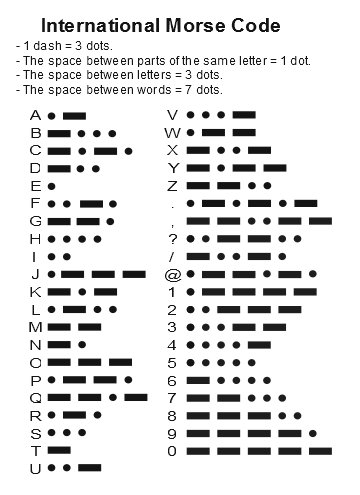
Learning Morse code is like learning any language. You have to practice, practice, practice. The first step you need to take is to get familiar with what the alphabet looks like in the Morse code. I have already provided the international Morse Code chart above. Take a Print out of it, carry it around, and study it whenever you get an opportunity.
The next step involves listening to the Morse Code. Only memorizing will not take you much far. You will have to actually listen to Morse code if you ever want to learn it. There are many websites from where you can download the sounds for free. Just google and you will get it. Listen to it and see if you can decipher any letters and if not, then practice religiously till you can.
 Tech blog