QR Code

A Quick Response Code commonly abbreviated as QR Code is a 2-Dimensional barcode that can be encoded with information similar to a barcode but QR codes can store much more data and take very less print space.
QR code is actually the trademark for a type of matrix barcode (or 2-D barcode). It was first designed in the year 1994 for the automotive industry in Japan. Barcodes are machine-readable optical labels that contain information about any product to which they are attached. In standard practice, QR codes often contain data for an identifier, locator, or tracker that points to a specific website or application. A QR code has four standardized encoding modes (numeric, byte/binary, alphanumeric, and kanji) to store data; extensions can also be used depending on the need. The Quick Response system became very popular due to its fast readability and more storage capacity compared to standard barcodes. Applications of QR codes include product tracking, document management, item identification, time tracking, and general marketing.

What are QR codes??

QR codes were introduced to the world by Japan where they are very common. They can be useful to take a piece of information from any transitory media and put it into a cell phone. QR Codes may soon be seen in magazine adverts, billboards, web pages or even on t-shirts. Once they are on your cell phone, they may give you details about that business, or details about the person wearing that t-shirt. QR codes can also show you a URL that you can click to see a movie trailer, or it may give you an offer code that you can use in an outlet.
The reason why QR codes are more useful than a standard barcode is that they can comparatively store much more data, including geo-coordinates, URL links, and text. Another important feature of the QR Code is that instead of requiring a bulky hand-held scanner to scan them, most modern cell phones can scan them.

How do they work??

QR codes consist of black squares arranged in a square-shaped grid on a white background. QR codes can be read by using an imaging device like a smartphone camera, and then processed by using Reed–Solomon error correction until the image can be properly interpreted. The data present on the QR code is then extracted from the patterns that are present in horizontal and vertical components of the image.

How could we use QR code??

Any business, no matter how small or big, can use QR codes in a multiple number of ways. You can auto-generate one and put it next to every product on your web site containing all the details about that product, the phone number to call and the link to the page so they can share all these details with their friends on their cell phone. You could also add one to your business card which will contain your contact details so it is easy for anyone to add you to their contacts on their cell phone.

QR codes can also be added to any print advertising, flyers, posters, invites, TV ads, etc. The printing of QR codes on physical media is one of the best ways to connect smartphones to online content with information like the following contained in them:
All the details about the product,
Contact details of the supplier/manufacturer,
Offer details,
Any relevant event details,
Competition details,
A discount coupon for next purchase etc,
All social media platforms like Twitter, Facebook, MySpace IDs,
A link to your business channel on YouTube,

All this information will help in managing many applications, some of which include:

Marketing (connecting consumers to content)
Inventory management (QR Codes can survive wear and tear)
Mobile Payments (cardless transactions)
Login authentication (Just like Whatsapp Web)
Identification (anti-counterfeiting, ID cards, ticketing, etc.)

A QR Code can be generated with the help of online QR Code Generators. The codes that you generate can then be decoded using any QR Code scanning application on your smartphones. There are many free websites on the internet that can provide QR code generation for free and these can be scanned by many smartphones on Android or IOS platforms. But their websites provide limited services for free and you will have to opt for their paid packages to actually use on a large scale for commercial purposes.
Hope this was helpful. Thanks
Barcodes

We purchase various product all the time and each time we do that, we interact with a barcode, but rarely or almost never do we give them any notice. Yet barcodes are a very crucial part in the effective and efficient running of any economy, from small businesses to large multinational companies.

So, What is a Barcode anyway?

Basically a barcode is a machine-identifiable code in the form of numbers and patterns of parallel lines with varying widths. But in reality a barcode is much more than that. Barcode systems today are an inevitable part of businesses and organizations which are used to track products, prices, and stock levels for management in a centralized computer software system allowing for exponential increases in productivity and efficiency.

The lines on a barcode are actually numbers and data and their pattern allowed basic information about any product to be conveniently read by a scanning device which is called a barcode scanner. This barcode scanner automatically enters all the product related data into a computer system. This duo vastly reduced the time to record product information and almost completely eliminated the potential for error in human data entry.

Barcodes initially came out with simple 1-D designs, consisting of simple black lines that could only be read by special barcode scanners. However, today barcodes come in a wide range of designs and most of them can even be read by mobile phones and other electronic devices.

Some historical aspects about Barcodes!!

The barcode has a very long and interesting history from its initial stages of development nearly 70 years ago. The technology behind the barcode is constantly changing, and we are always discovering ways to put more and more information into these codes. It all started in 1949 on a beach when Joseph Woodland, a mechanical engineer at Drexel University, drew a set of parallel lines in the sand that “represented a kind of ‘long form’ of dots and dashes” or Morse code. Woodland had been thinking about the ways Morse code might be used to solve a problem his colleague Bernard Silver had presented to him. Months earlier, Silver had overheard the president of a grocery chain appeal to the dean of Drexel University to help him devise a system to automate the grocery checkout process.

On the fine day of October 20, 1949, Silver and Woodland filed a patent for a “Classifying Apparatus and Method”, this was the first barcode concept. They were finally awarded their patent in October 1952, and while this idea was intriguing to many companies and industries, the scanning technology aka the barcode reader, which would actually allow the barcode to become one of the most important symbols in the world did not yet existed.

The 1950s and 1960s were very happening for the barcode technology as various companies and industries tried very hard to develop the barcode technology. The first implementation was that of KarTrak system which was developed by David Collins from the Boston and Maine Railroad company. This system was then selected as the standard by the Association of American Railroads and by the year 1974, almost 95% of the AAR fleet was tagged with this system. But, the system could never become fully functional and its use was discontinued in the late 1970s.

The actual breakthrough that lead to the global outreach of barcodes was the invention of the Universal Product Code. In 1966 the National Association of Food Chains began to ponder over the idea of automated checkout systems. At that time, RCA had the rights to Silver and Woodland’s original patent and they had began a project to develop an effective system.

After that, in the mid of 1970s, the NAFC in U.S. established the Supermarket Ad Hoc Committee on a Uniform Grocery Product Code, to create the basic guidelines for barcode technology development and an effective and usable coding system. This finally led to the creation of the standardized 11-digit code to identify products.

IBM also jumped in by employing George Lauer to begin work on what would become the standard UPC linear 1-Dimentional barcode. The critical moment was in 1974 on June 26th when the first ever barcode was scanned in a supermarket in Troy, Ohio. It was a pack of Juicy Fruit gum from Wrigley’s.

Over the times, barcode has evolved from simple lines to complicated 2-D designs and in the contemporary world, they help people track everything from a can of coke to the top secret documents in the Department of Defense.

Some Important types of Barcodes

Code 128

Code 128 is a high-density linear barcode symbology. It is used for alphanumeric or numeric-only barcodes. It can encode all 128 characters of ASCII and, by use of an extension symbol (FNC4), the Latin-1 characters also.

A Code 128 barcode has seven parts:

Part 1: Quiet zone
Part 2: Start symbol
Part 3: Encoded data
Part 4: Check symbol (mandatory)
Part 5: Stop symbol
Part 6: Final bar (considered part of stop symbol sometimes)
Part 7: Quiet zone

The check symbol is then calculated by a weighted sum (modulo 103) of all symbols.

EAN 13

International Article Number (aka European Article Number or EAN) is a standard of barcode symbology used in the global trade to identify a retail product, in a specific packaging, packaged by a specific manufacturer. The standard has now been subsumed in the Global Trade Item Number standard by the GS1 organization; the same numbers can be called as GTINs and can be coded in other barcode symbologies defined by GS1. EAN barcodes are used all over the world for lookup at retail points of sale, but they are also used as numbers for other purposes like wholesale ordering.

The most commonly used standard is the thirteen-digit EAN-13, which is the superset of the 12-digit Universal Product Code standard developed in 1970 by George J. Laurer. An EAN-13 number includes a 3-digit GS1 prefix which indicates the country of registration or a special type of product. A prefix with first digit “0” indicates a 12-digit UPC-A code will follow. A prefix with first two digits of “45” or “49” indicate that Japanese Article Number (JAN) will follow.

HOW DO BARCODES FUNCTION?

Barcodes work by a combination of a symbology and a barcode scanner that can read those symbology and convert it into useful information. The barcodes often provides us with information related to a product’s origin, type, price, and location. The scanner scans the barcode and puts all the information stored in it into a system which is often some type of database.

Some of the ways businesses use barcodes:

Keeping a track of inventory. An inventory tracking system consists of a software and a barcode scanner. Inventory items will have barcode labels. When you remove any item from stock, you just scan the barcode to adjust the available count in the inventory tracking software, instead of having to type in all the details.
Keeping a track of assets. Businesses, no matter how big or small, has multiple assets. Barcoded asset tags are attached to each of the assets, and can be scanned to check items in or out in your tracking software. It’s a great method to improve accountability and makes audits much easier.
One easy way to incorporate barcodes into your business is to use a complete barcode system which are available in the market. However, there are also many online tools that you can use to generate barcodes without any investment. Just google free barcode generator to find a free tool and start creating a barcode for your business.

Morse Code

The Morse Code

Modern communication devices like cell phones and telephones may look like an inevitable part of human communication technology. It feels like these things have existed since eternity, but these are comparatively very young technologies. This does not mean in any way that there was no communication over longer distances between people back in the day. People communicated through Morse code. So, Morse code can be termed as the predecessor to modern communication devices. Despite being a technology that is over one and a half century old, it’s still used today among some radio users and by some ship crews. You might even have a grandpa who used it on his ham radio. Learning Morse is a fun and satisfying hobby now a days and you can share it with all oldies in the neighbourhood. There are always some gramps in all neighbourhood who still know this archaic art. Back in the day, Morse code was one of the most desired man skills.

Historical Archives of Morse Code

Morse code was invented by a American artist named Samuel F. B. Morse in the 1830s. Along with the American physicist Joseph Henry, and Alfred Vail, he developed an electrical telegraph system. They began work on the electric telegraph in 1832, developed a practical system in 1844, and patented this technology in 1849. Around 1837, Morse, developed an early forerunner to the modern International Morse code. The code that Morse developed for use with his system went through a few transformations before we saw the code we’re familiar with today. Initially, Morse code transmitted only numbers. The transmission’s receiver would then use a dictionary to translate the numbers into words. But that proved to be too much time consuming and tedious. Soon the code was expanded to include letters and punctuation.

On 24th May 1844, Morse code was used for the first time. “What God hath wrought.”; was the first ever message that was transmitted via Morse code. This was done by Samuel F.B. Morse himself. The original telegraph system had an apparatus on the receiving end that spat out a string of paper with indentations over it. Short indentations were called “dots” and longer ones were called “dashes.” As telegraph users became more proficient, they soon dispensed with the paper tape and deciphered code by ear. In those days telegraph users were considered highly skilled if they could decipher Morse code by ear.

Ten years after the first telegraph line was opened in 1844, over 23,000 miles of telegraph line crossed America. The telegraph and Morse code had a very positive effect on the development of the American West. Railroad companies used it to communicate between stations and telegraph companies started to pop up everywhere, which shortened the amount of time needed to communicate across the country significantly.

During this time, European countries also had developed their own system of Morse code. The code used in America was called American Morse code or Railroad Morse code; while the code used in Europe was called Continental Morse code.

In the 1890’s radio frequency communication was invented and Morse code was used for transmitting messages at sea. As radio frequencies got longer, international communication soon became a possibility. This created a need for an international standard code. In 1912, the International Morse code was adopted for international communication. However, many railroads and telegraph companies continued using Railroad Morse code because it was faster to send. Today, American Morse code is almost extinct.

Morse code became extremely important in maritime shipping and aviation industries. It was mandatory for pilots to know how to communicate using Morse code up until the 1990s. Today Morse code is mostly used among amateur radio users. As a matter of fact, until 2007, if you wanted to get an amateur radio license in America, you had to pass a Morse code proficiency test.

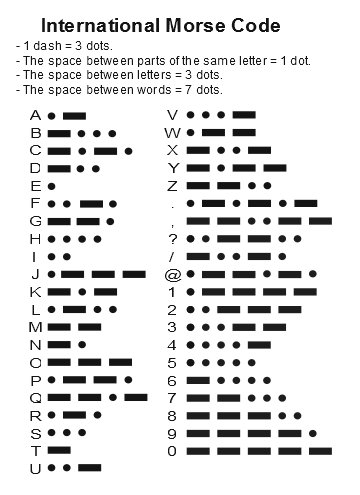
international morse code chart letters numbers
The Morse Code Chart

Learning Methods for Morse Code

Farnsworth method involves learning to send and receive Morse code letters and other symbols at their full target speed, that is with normal relative timing of dots, dashes, and spaces in each symbol for that speed. This method is named after Donald R. “Russ” Farnsworth. Initially, exaggerated spaces between symbols and words are used, to provide “thinking time” to the learner to make the sound “shape” of the letters and symbols. The spacing is then reduced slowly and steadily with practice.

Another popular teaching method is the Koch method, named after the German psychologist Ludwig Koch, which uses the full target speed from the outset but begins with only two characters. When those two characters are copied with 90% accuracy, an additional character is added, and this goes on until the full character set is learned to perfection.

In North American region, individuals have increased their ability for code recognition speed (after initially memorizing the characters) by listening to the code practice transmissions broadcasted by W1AW, the American Radio Relay League’s HQs.

Mnemonics

Visual mnemonic charts have been devised over the ages to aid in the learning of Morse code. In 1918, Baden-Powell included one of the first ever in a Girl Guides handbook.

In the UK, many people learned the Morse code by the means of a series of words or phrases that have a similar rhythm as a Morse character. For example, “Q” of Morse is analogous to dah-dah-di-dah, this can be memorized by the line “God save the Queen”, and the Morse for “F” is analogous to di-di-dah-dit, which can be memorized by the line “Did she like it.”

A popular Morse code rhythm from the 2nd World War period derives its source form Beethoven’s Fifth Symphony, the opening line of which was regularly played in the BBC broadcasts. The timing of these notes are analogous to the Morse character “V”, di-di-di-dah, perceived as “V for Victory”.

A Mnemonic chart for learning Morse code

Some Learning Tips

Learning Morse code is like learning any language. You have to practice, practice, practice. The first step you need to take is to get familiar with what the alphabet looks like in the Morse code. I have already provided the international Morse Code chart above. Take a Print out of it, carry it around, and study it whenever you get an opportunity.

The next step involves listening to the Morse Code. Only memorizing will not take you much far. You will have to actually listen to Morse code if you ever want to learn it. There are many websites from where you can download the sounds for free. Just google and you will get it. Listen to it and see if you can decipher any letters and if not, then practice religiously till you can.

Design a site like this with WordPress.com
Get started